Cordaville & Southborough History
Brookside Farm sits on land that was once part of Cordaville, the industrial heart of 19th-century Southborough. This is a deeper look at the mill village, the textile industry, and the community that shaped our homestead.
Three Villages
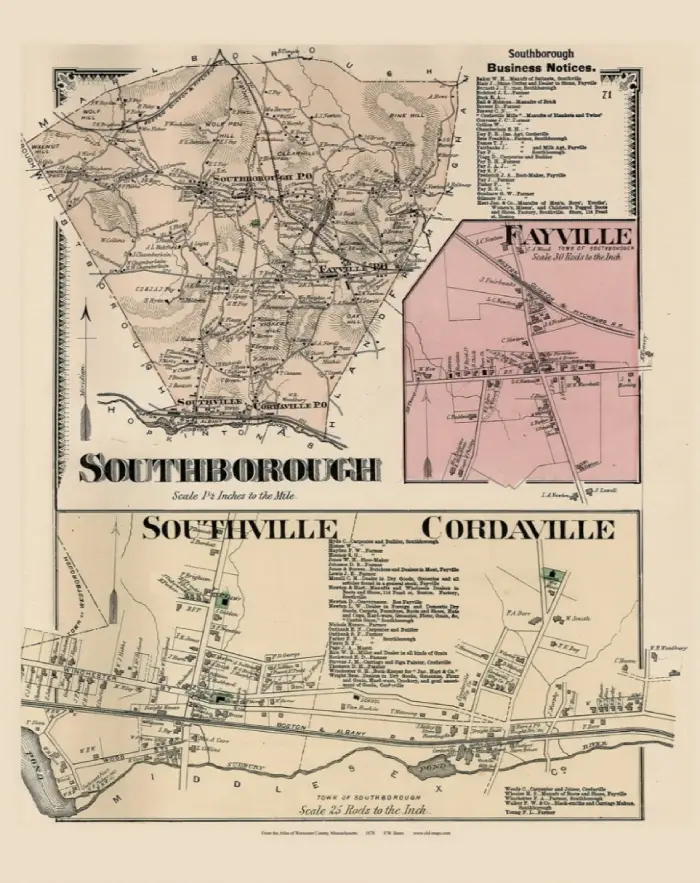
In the 1800s, Southborough was known by its three distinct villages: Fayville, Southville, and Cordaville. Each had its own post office, businesses, and character, connected by the railroads that linked the town to Boston and Worcester.
Cordaville, in the southern part of town along the Sudbury River, was the industrial center. Fayville lay to the east, and Southville sat beside Cordaville along the Boston & Albany Railroad. An 1870 map of the town shows how densely these villages were built compared with the surrounding farmland, and how central those mills were to daily life.
Cordaville: A 19th-Century Mill Village
The site of today's Southborough Station parking lot was once home to the Cordaville Manufacturing Company, founded in 1847 and later renamed the Cordaville Woolen Company in 1876.
In 1847, Milton H. Sanford of Medway purchased property in Southborough, Ashland, and Hopkinton. Within seven months he built a stone textile mill, a machine shop, and a planing mill. He named the village Cordaville after his wife, Cordelia.
Sanford also built worker housing on Central (now Southville), Cottage, and Parker streets, and a company store on Main Street. The result was a classic New England mill village: homes, commerce, and industry clustered around the river and the railroad.
Although the main mill buildings are gone, many worker houses remain, along with structures such as the storehouse, stone arch bridges, and the mill pond in the wooded park east of the station parking lot.
Water Power on the Sudbury River
The mill complex drew its power from the Sudbury River. Dams created millponds for water storage. Water was channeled from a mill pond through a narrow canal called a head race, then through an airtight pipe (a penstock) to turn a waterwheel. Spent water returned to the river through a canal called a tail race.
By mid-century the mills also used steam power alongside water, allowing production to grow even when river flow was low.
Southborough's Textile Industry
The Cordaville mills produced cotton clothing for Southern plantations and, during the Civil War, woolen blankets for Union soldiers. In 1871 the works were purchased by Adolph Merriam and reorganized in 1876 as the Cordaville Woolen Company.
By the turn of the century, the company employed over 100 workers and grossed over $100,000 annually. Federal census records show how the industry grew and shifted over three decades:
| Year | Operator | Products | Power | Workforce |
|---|---|---|---|---|
| 1850 | Cordaville Manufacturing Co. | Domestics | Water | 20 men, 40 women |
| 1860 | M.H. Sanford | Plantation goods | Water & steam | 41 men, 59 women |
| 1870 | Cordaville Mills Co. | Woolen & jute ($175,000 blankets; $3,000 twine) | Water & steam | 50 men, 75 women, 35 children/youth |
Source: Federal census manufacturing schedules, as presented by the Southborough Historical Society.
The Fire of 1855
In October 1855, a fire destroyed the cotton factory and claimed several lives. According to the Boston Evening Transcript of October 31, 1855, the blaze began around 9:30 a.m. in the picker room in the basement and spread so quickly that workers jumped from third- and fourth-story windows to escape.
Among those killed and wounded were young workers such as Maria Carney, about sixteen or seventeen years old, who died from injuries after jumping. The financial loss was estimated at $80,000 to $90,000, with only about $30,000 covered by insurance.
It took Sanford roughly two years to rebuild. During that time he supported the families of his workers. It is a reminder that Cordaville was not only an industrial site, but a community bound together by the mill.
Railroad & Community Life
The Boston and Worcester Railroad, built in 1834, was the first scheduled passenger train in Massachusetts. A depot was built in Cordaville in 1855 after a petition from residents. The trip from Boston to Worcester took two and a half to three hours, with ten stops along the way.
Village life centered on more than the mill floor. Fitzgerald's Store, built around 1850, served as the company store, a meeting hall, the site of the first Catholic Mass in Cordaville (1851), and later a post office operated by the Wright brothers in 1870.
Inside the mill, conditions were demanding. Machinery in the spinning room was so heavy and powerful that vibrations caused upper floors to sway, and the owner eventually moved looms to a lower floor to keep the building from collapsing.
Our Homestead in That Story
The George O. Wilson Homestead, recognized by the Southborough Historical Commission and dating to about 1855, stands in this same Cordaville landscape. Mr. Wilson was a manager at the mill. The land that is now Brookside Farm was part of that worker community, built on industry, the river, and hard work.
After Mr. Wilson, the homestead passed from family to family until the Deschamps family took stewardship in 1964. Today we handcraft outdoor wood goods on that same ground, carrying a new chapter of an old story.
Historical information on this page is drawn from interpretive materials of the Southborough Historical Society and the Southborough Public Library. We are grateful for their work preserving Cordaville's story.